
Fermented Foods vs Probiotic Supplements: Which Is Better for IBS?
Posted by The CodonRX Science Team on Jun 3rd 2026
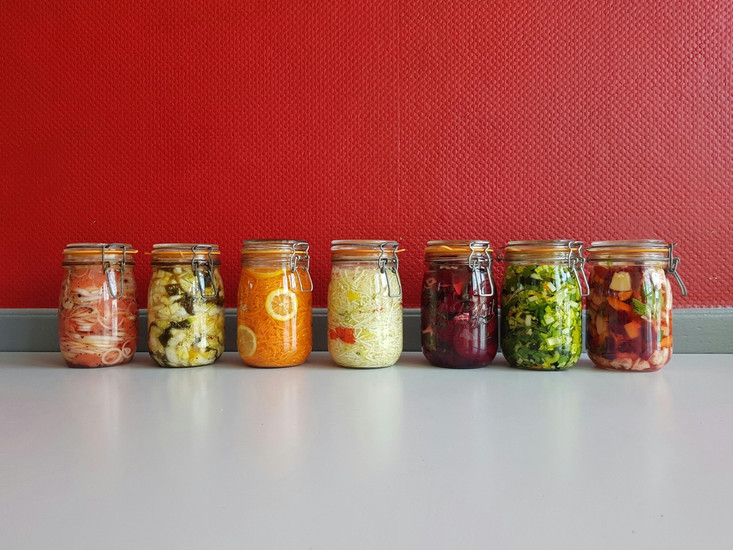
The advice to “eat more fermented foods” for gut health has become standard. Yogurt, kimchi, kefir, sauerkraut, and kombucha are routinely recommended as natural sources of beneficial bacteria — a “whole food” alternative to popping a probiotic capsule.
The advice isn’t wrong. Fermented foods do contain live microorganisms, and regular consumption is associated with a more diverse gut microbiome. But for people with IBS managing specific symptoms, the comparison to a targeted probiotic supplement involves trade-offs that are rarely explained clearly. Here’s an honest breakdown.
What Probiotic Strains Are Actually in Fermented Foods?
Most fermented foods contain live cultures — but the strains vary widely, the bacterial counts are inconsistent, and the specific organisms present depend heavily on how the food was made, stored, and handled.
Yogurt
Live cultures required by FDA definition. CFU counts vary widely by brand and product age. “Probiotic yogurt” with added strains is inconsistently dosed — and most strains are generic commodity species, not research-characterized.
Kefir
Higher bacterial diversity than yogurt. Beneficial for gut diversity in healthy people. The complexity that makes kefir interesting also makes it impossible to attribute effects to any specific organism — not ideal if you need targeted, predictable action.
Kimchi & Sauerkraut
Live cultures only in unpasteurized versions. Most commercial kimchi and sauerkraut is pasteurized, which kills the bacteria. High fiber content benefits gut health regardless — but the probiotic value depends entirely on whether the product was pasteurized.
Kombucha
Contains live bacteria and yeasts, but the composition is highly variable and not standardized. High sugar content in commercial versions may be counterproductive for some IBS presentations. Modest gut health benefit; not comparable to a characterized probiotic.
Are Fermented Foods Good for Gut Health and IBS?
Fermented foods offer genuine benefits that shouldn’t be dismissed:
- Microbial diversity. Regular consumption of varied fermented foods is associated with higher gut microbiome diversity — a marker generally correlated with gut resilience and metabolic health.1
- Fiber and nutrient density. Many fermented foods (yogurt, kefir, kimchi) contain fiber, vitamins, and minerals alongside the live cultures. These contribute to gut health independent of the probiotic effect.
- Long-term integration. Eating fermented foods as part of a regular diet may produce cumulative benefit that’s harder to achieve — and sustain — with supplementation alone.
- Low risk. For healthy individuals without specific conditions requiring targeted intervention, fermented foods are a low-risk, accessible way to support the microbiome.
Why Aren’t Fermented Foods Enough to Manage IBS Symptoms?
For IBS sufferers managing specific, measurable symptoms, fermented foods have three significant limitations compared to a well-characterized supplement.
1. Dose is unpredictable. The bacterial count in fermented foods is highly variable and declines as the product ages. A cup of yogurt contains anywhere from fewer than 1 million to several billion CFUs, depending on the brand, storage, and date. You cannot reliably dose fermented foods the way you can a capsule with a guaranteed CFU count at expiration.
2. Strains are generic. The bacteria in commercial yogurt and kefir are selected for fermentation performance — flavor, texture, consistency — not for clinical effect in the human gut. They are not patented strains with published adherence data, clinical studies, or documented interactions with the gut immune system. “Contains live cultures” is not equivalent to “contains clinically characterized organisms.”
3. LTA is present in all of them. Every Lactobacillus and Bifidobacterium strain in fermented foods — the same species families in most probiotic supplements — carries lipoteichoic acid (LTA) on the bacterial cell wall. For IBS sufferers whose gut lining is already reactive, adding LTA-carrying organisms through either fermented foods or standard supplements may amplify inflammation rather than resolve it. This is not a reason to avoid fermented foods in general — but it is a reason to think carefully about the specific strains you’re introducing to an already-sensitized gut.
Fermented foods improve microbiome diversity. A targeted probiotic supplement provides a specific, dosed organism with documented properties. These are not the same intervention — and for IBS, the distinction matters.
Fermented Foods vs. Probiotic Supplements: Which Is Better for IBS?
| Factor | Fermented Foods | Targeted Supplement |
|---|---|---|
| Dose consistency | Highly variable; declines with age | Guaranteed CFU at expiration (if stated) |
| Strain specificity | Generic fermentation strains; not research-characterized | Can be specific, patented, and independently validated |
| Microbiome diversity | High — multiple species; associated with diversity benefits | Low — typically 1–3 strains; targeted action |
| LTA exposure | Present in all standard Lactobacillus / Bifidobacterium fermented foods | Present in all standard strains; absent in NCK2025™ specifically |
| Nutrient value | Fiber, protein, vitamins — gut benefit beyond bacteria | Bacteria only; no additional macronutrient value |
| Best suited for | Long-term microbiome diversity; general gut maintenance | Targeted intervention: post-procedure recovery, IBS symptom management, specific clinical goals |
Some fermented foods — particularly kefir, yogurt with lactose, and kombucha — may worsen IBS symptoms in people with FODMAP sensitivities. Fermentation reduces but does not eliminate FODMAP content. If you follow a low-FODMAP diet, check specific products against your protocol before adding fermented foods regularly.
Should You Eat Fermented Foods or Take a Probiotic Supplement for IBS?
Fermented foods and probiotic supplements are not competitors — they serve different functions. The research case for dietary fermented food consumption for general gut health is solid. For IBS sufferers who need a targeted, consistent intervention with a strain whose behavior in the gut has been characterized, fermented foods are insufficient on their own.
If you’re using a probiotic specifically to manage IBS symptoms, the relevant questions are: what strain is in it, what does the published research say about that specific strain in a reactive gut, and does it carry LTA? A generic Lactobacillus acidophilus supplement — whether from a capsule or from a cup of yogurt — provides LTA along with whatever benefit it offers.
NCK2025™, the patented strain in CodonRX, is the only commercially available L. acidophilus strain engineered to remove LTA while retaining the species’ well-characterized gut adherence and mucosal support properties. Two US patents (9,340,792 and 9,980,992) cover the technology. The mechanism was published in PNAS in 2011 — independently, not by the company.2
Discover what CodonRX can do for you.
Shop CodonRX® 30-day supply · Patented NCK2025™ · Made in the USAReferences & Notes
- Wastyk HC, et al. “Gut-microbiota-targeted diets modulate human immune status.” Cell. 2021;184(16):4137–4153. A randomized controlled trial demonstrating that high-fermented-food diets increase microbiome diversity and decrease inflammatory markers in healthy adults.
- Mohamadzadeh M, et al. “Regulation of induced colonic inflammation by Lactobacillus acidophilus deficient in lipoteichoic acid.” Proceedings of the National Academy of Sciences (PNAS). 2011;108 Suppl 1:4623–30. Establishes the TLR2/LTA mechanism and validates NCK2025™ as a non-inflammatory alternative to wild-type L. acidophilus.
These statements have not been evaluated by the Food and Drug Administration. This product is not intended to diagnose, treat, cure, or prevent any disease.