
Study: LTA in Probiotics and Its Role in Gut Inflammation
Posted by The CodonRX Science Team on May 12th 2026
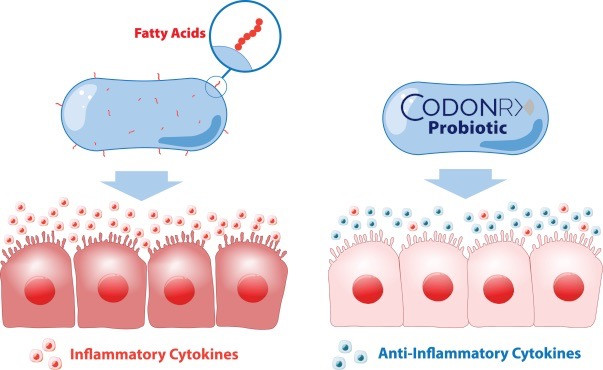
Most people think of probiotics as straightforwardly good — more bacteria, better gut health. But every bacterium that enters your gut carries something on its outer surface, and that surface is what your gut's immune system reads first. For a large portion of probiotic strains on the market, what's on that surface can trigger an immune response that works against people with IBS, not for them.
That molecule is called lipoteichoic acid — LTA. A 2012 study published in the Journal of Inflammation by Zadeh and colleagues examined what LTA actually does when it reaches gut tissue, and the findings reframe what it means to choose the right probiotic.
What Is LTA and Why Is It in Probiotics?
LTA is not an additive or a contaminant. It is a structural part of the outer cell wall of virtually every Gram-positive probiotic bacteria — Lactobacillus, Bifidobacterium, the strains in every probiotic you've seen on a pharmacy or health food store shelf. It is as much a part of those bacteria as skin is a part of the human body. You cannot remove it by changing the dose, the brand, or the CFU count. It is there by default, on every cell, in every capsule.
What Does LTA Do to the Gut's Immune System?
The gut lining is equipped with immune sensors whose job is to read what's arriving and decide how to respond. These sensors — called Toll-like receptors, or TLRs — recognize specific molecules on bacterial surfaces. LTA is one of the molecules they recognize. And when they do, they initiate an inflammatory response.
The Zadeh study found that LTA behaves similarly to lipopolysaccharide (LPS) — a molecule found on harmful bacteria and well established as a driver of inflammation. The same immune sensors that respond to dangerous pathogens also respond to the LTA on a standard probiotic's surface. That recognition triggers an inflammatory signaling cascade — the biological process behind the pain, bloating, and urgency that define IBS symptoms.
Who Is Most Affected?
Not everyone responds the same way. In a gut with well-regulated immunity, the inflammatory signal from LTA may be minor and short-lived. But the study specifically identified individuals with pre-existing inflammatory conditions — like IBS — as most susceptible. In an already over-reactive gut, that same LTA signal compounds the existing inflammation rather than resolving it.
This helps explain something many IBS sufferers have experienced without being able to explain: taking a well-reviewed, high-CFU probiotic and feeling no better — or feeling worse. The bacteria colonized. The label claim was accurate. But the LTA on every bacterial surface was simultaneously telling the gut's immune system to activate an inflammatory response.
What Does This Mean for Probiotic Selection?
Because LTA is a structural feature of virtually all standard probiotic strains, adjusting dose or switching brands doesn't change the underlying dynamic. The relevant question for someone with a sensitive or inflammatory gut isn't which probiotic has the most strains or the highest CFU count — it's what those bacteria are doing to the gut's immune system at the surface level once they arrive.
That's the question this research raised. And it's the foundation for why a probiotic engineered without LTA produces a different outcome for IBS sufferers than any standard strain can.
Study: Zadeh et al. (2012)
- Published in: Journal of Inflammation, 9, 7
- Key finding: LTA on standard probiotic bacteria activates gut immune sensors (TLRs) and initiates inflammatory signaling
- Most affected: People with IBS or other pre-existing inflammatory gut conditions
- What it means: LTA is a structural feature of virtually all standard probiotics — switching brands or increasing dose doesn't remove it
Remove inflammatory triggers at its source
Shop CodonRX® 30-day supply · Patented NCK2025™ · Made in the USA